C-Section vs Normal Delivery: The Honest Comparison
C-section vs normal delivery — cost, recovery, risks, and the honest truth about India's rising C-section rate. A complete 8-min decision guide for expecting mothers in Delhi, Noida, Gurgaon, Ghaziabad and Faridabad.
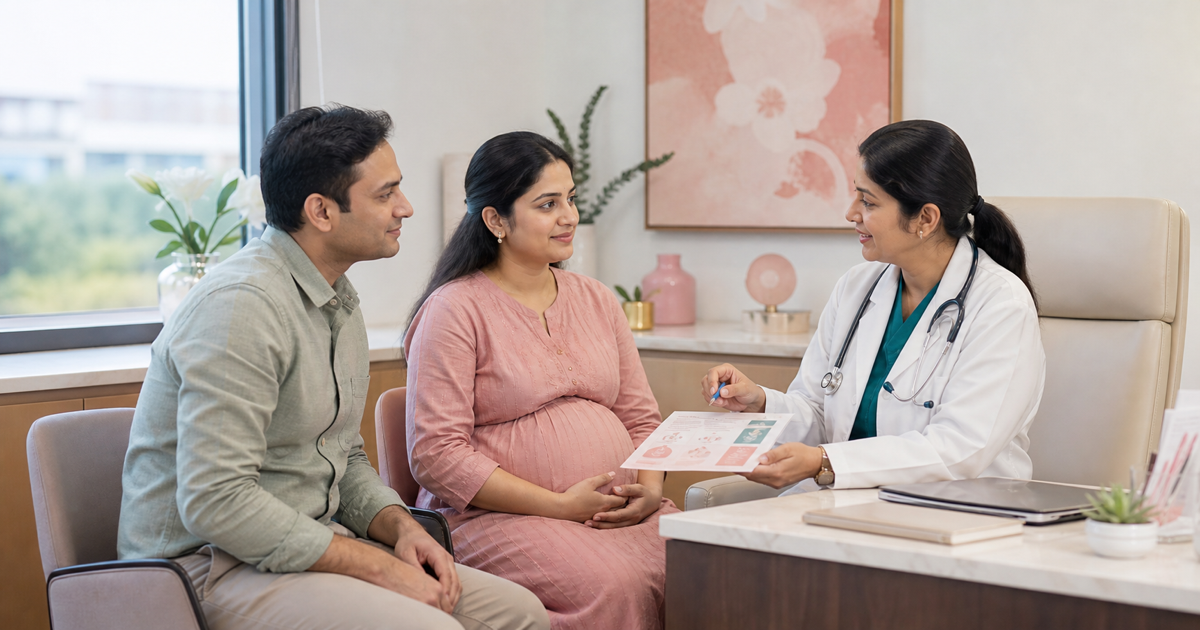
Somewhere between your 32nd and 36th week of pregnancy, a conversation is going to happen. Your gynaecologist will bring up delivery mode. In Delhi NCR — where nearly 1 in 2 hospital births now end in a C-section — that conversation is more loaded than it should be. This guide gives you the honest, complete comparison of C-section vs normal delivery: recovery, cost across Delhi/Noida/Gurgaon/Ghaziabad/Faridabad, when each is genuinely the right choice, VBAC, and how to have the informed conversation you deserve with your doctor.
What is normal delivery?
Labour typically lasts 4 to 24 hours for first-time mothers and is often shorter for second and third pregnancies. Pain management options range from breathing techniques and warm water immersion to nitrous oxide and epidural analgesia. Recovery is generally quick: most women are walking within hours and physically well within a week or two.
What is a C-section?
The procedure typically takes 45 to 60 minutes. C-sections are classified as planned (elective) — scheduled in advance for a specific medical reason — or emergency, performed when a situation during labour makes vaginal delivery unsafe. Both are safe, common, and life-saving when genuinely needed.
C-Section vs Normal Delivery: the complete side-by-side comparison
| Feature | Normal Delivery | C-Section |
|---|---|---|
| Delivery method | Through birth canal | Surgical incision |
| Duration | 4–24 hours (labour) | 45–60 minutes |
| Hospital stay | 24–48 hours | 2–3 days |
| Anaesthesia | None or epidural | Spinal or epidural |
| Physical recovery | 1–2 weeks | Similar once home |
| Cost (Delhi NCR, private) | ₹40K–1.2L | ₹80K–2.5L |
| Blood loss | Lower | Roughly twice as high |
| Breastfeeding start | Immediate | Within a few hours |
| Impact on next pregnancy | Minimal | Higher risk of complications |
| Infection risk | Lower | Higher (wound-related) |
The Indian reality: why our C-section rate is so high
C-section rate: WHO vs India
Why so high? The reasons are a mix of medical caution, convenience, and system pressure: fear of medico-legal risk, the ease of scheduling a planned C-section over unpredictable labour, staffing constraints in busy private hospitals, cultural preference for auspicious delivery dates, patient requests, and in some settings, economic incentives that reward higher-priced procedures. Not every C-section is over-recommended — but many are.
When normal delivery is right
Choose normal delivery when…
- Healthy, low-risk pregnancy with no complications
- Baby is head-down (cephalic) at 36 weeks
- Adequate maternal pelvis and no anatomical concerns
- No prior classical C-section (VBAC candidates included)
- Blood pressure, sugar and other conditions are controlled
- You want faster recovery and lower cost
- You’re planning more children in future
C-section is truly needed when…
- Placenta previa (placenta covering the cervix)
- Breech position at term (after failed external cephalic version)
- Twins or triplets with position complications
- Prior classical (vertical) C-section incision
- Fetal distress that doesn’t resolve
- Failure to progress in labour after adequate time
- Cord prolapse or placental abruption
- Certain maternal medical conditions (severe pre-eclampsia, active herpes lesions)
A C-section is not a failure. And a normal delivery is not always available. The safest choice is the one your medical situation genuinely calls for.
When a C-section may be over-recommended
Questions to ask before agreeing
Not every C-section recommendation in India is medically necessary. If your doctor is recommending one, and none of the specific reasons in the previous table clearly apply, you have every right — and every reason — to ask more questions.
Signs the recommendation may deserve a second opinion:
- “Your baby looks big” without a recent ultrasound weight estimate
- Recommendation before you’ve reached 39 weeks (barring specific indication)
- C-section suggested only because you’re over 35 (age alone is not an indication)
- Prior C-section without discussing whether you’re a VBAC candidate
- “Let’s just schedule it” without a specific medical reason given
- Emergency framing (“something might go wrong”) without concrete data
- Convenience-driven timing to fit a doctor’s schedule
Fair questions to ask: “What specifically makes normal delivery unsafe in my case?”, “What’s the estimated fetal weight based on today’s scan?”, “Am I a candidate for a trial of labour?”, and “Can I take a day to think about this?”. A good doctor welcomes these questions.
Cost in Delhi NCR: the full picture
Normal delivery cost
- Standard package₹40K–70K
- With epidural₹55K–90K
- Premium suite₹80K–1.2L
- Typical total₹40K–1.2L
C-section cost
- Standard package₹80K–1.5L
- Emergency C-section₹1.2L–2L
- Premium suite₹1.8L–2.5L
- Typical total₹80K–2.5L
Most Delhi NCR maternity hospitals offer packages, EMI options, and many corporate insurance plans cover both delivery types. Ask for a transparent, itemised estimate at booking — and clarify what happens if a planned normal delivery converts to an emergency C-section.
Recovery: the honest timeline
Normal DeliveryRecovery journey
- Walking with support within a few hours. Skin-to-skin and breastfeeding start immediately.
- Hospital discharge for most healthy deliveries.
- Perineal soreness, some bleeding (lochia), fatigue. Move gently, stay hydrated.
- Most physical restrictions ease. Emotional adjustment continues.
- Full recovery for most women. Postpartum check with your doctor.
C-SectionRecovery journey
- Oral intake begins depending on your general wellbeing. IV pain relief, urinary catheter still in place.
- Walking starts. Catheter removed. Skin-to-skin and breastfeeding well underway.
- Hospital discharge depending on your general wellbeing.
- Healing at home. Gentle activity, wound care. Rest of the healing is more or less same as normal delivery.
- Most physical restrictions ease. Postpartum check and gradual return to activity.
- Full internal healing. Discuss family planning and future pregnancy timing.
Post-delivery emotional recovery matters as much as physical — regardless of delivery mode. If you’re feeling low, disconnected or overwhelmed in the weeks after birth, our guide on postpartum emotions and depression is worth reading.
Can you have a normal delivery after a C-section? (VBAC)
VBAC is a genuine option — and one many Indian women aren’t offered even when eligible. You’re typically a good candidate if your previous C-section used a standard lower-segment (horizontal) incision, the reason for it doesn’t apply this time, you have at least 18–24 months between deliveries, and there are no other complications this pregnancy. Ask your gynaecologist explicitly whether VBAC is an option for you.
Impact on your baby: what the evidence shows
Both routes deliver healthy babies every day. Vaginal birth passes helpful microbes to the baby (seeding the gut microbiome), allows a gradual respiratory transition, and enables immediate skin-to-skin contact. C-sections skip this bacterial exposure and involve a more abrupt respiratory transition, which is why babies born by C-section have slightly higher rates of initial breathing difficulty. When medically indicated, however, a C-section is unquestionably safer — the risk of not doing it is far higher than any of these minor differences.
Making your birth plan
- At 32–34 weeks, have a detailed birth-mode conversation with your gynaecologist
- Write a flexible birth plan covering preferences, pain relief, immediate skin-to-skin, and who’s in the room
- Discuss what happens if a planned normal delivery needs to become a C-section — who decides, based on what
- Ask about the hospital’s VBAC policy if this is a repeat pregnancy after C-section
- Involve your partner or support person in the discussions
- Prepare for either outcome emotionally — birth doesn’t always follow the plan
Nutrition and general fitness during pregnancy meaningfully affect your delivery experience. Our trimester-by-trimester pregnancy diet guide covers this in depth. And for women expecting after 35, delivery-mode conversations often start earlier — see our pregnancy after 35 guide.
Frequently asked questions
Your informed birth is our priority
Whichever delivery mode is right for you — and only your medical picture can decide — you deserve a team that treats you as a partner, not a schedule. One that tells you the honest indication for anything they recommend. One whose C-section rate reflects medical need, not convenience.
At FemmeNest — Centre for IVF & Gynaecology in East Delhi, our maternity team has supported over 5,000 pregnancies across Delhi, Noida, Gurgaon, Ghaziabad and Faridabad, and we’re committed to encouraging normal delivery wherever it’s safe — and to performing C-sections only when they’re genuinely needed. Come talk to us. Ask hard questions. That’s exactly what we’re here for.
Plan Your Birth Journey With Us
Book a maternity consultation with our team to discuss your delivery plan, ask every question you have, and get honest, evidence-based guidance on what’s right for you and your baby.